

Has Technology Made Life More Complicated?
Ask an Expat! Navigating Digital Borders

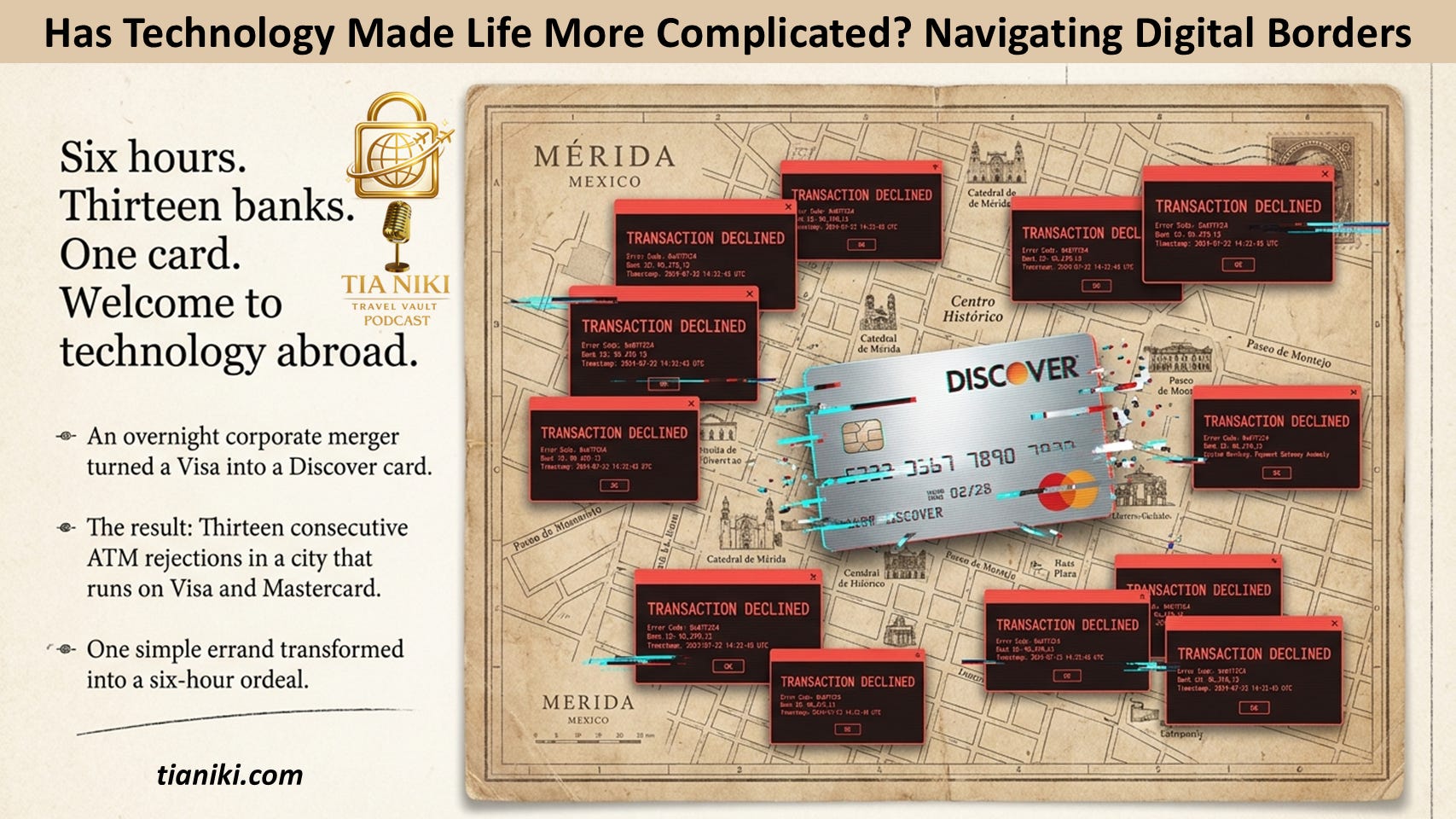
I spent six hours driving around Merida going from bank to bank.
Thirteen banks. Twelve rejections. My American debit card declined at every single one until I finally pulled into an HSBC and the machine accepted it. Six hours. One card. One city. One problem that should not have existed. Finally finding ONE bank that would accept by card and give me access to my OWN money!
That is technology in the expat life. Not the glossy version. The real one.
Here is what happened. My bank merged with another institution. The card changed. What was once a Visa or Mastercard became a Discover card overnight. And Mexico, like much of the world outside the United States, runs primarily on Visa and Mastercard. Discover is not widely accepted here. American Express is barely tolerated. So one corporate merger that I had no say in, no warning about, and no control over turned a simple errand into a six hour ordeal.
That is the technology story nobody tells you before you move abroad.
In my opinion what technology replaced. I am not here to say technology is bad. I am here to say it complicated things that used to be simple. And sometimes the simplicity we lost mattered more than we realized.


Remember corded phones? You would talk for hours. Fall asleep on the phone with someone you loved. The voice was the connection. There was no other option so you used it fully.
Text messages replaced that. Then social media replaced text messages. And somewhere in all that replacing we lost the voice. We kept the connection in name but hollowed out what it actually felt like.
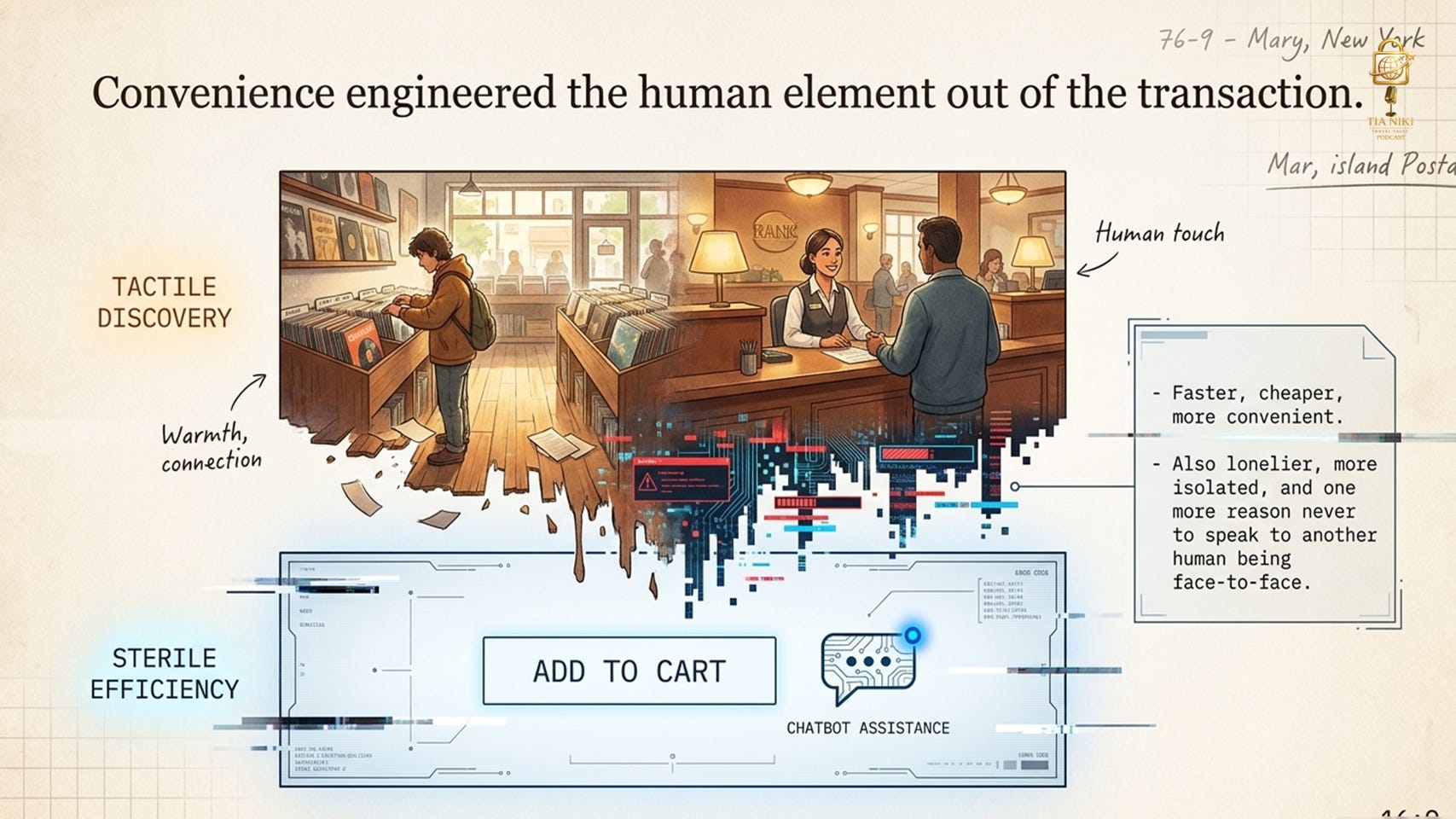
Tower Records. You walked in, you touched the album, you talked to someone behind the counter who knew music. You had an experience. Online shopping replaced that. Faster, cheaper, more convenient. Also lonelier. Also more isolated. Also one more reason not to leave the house.
Food delivery. Same story. Easier. Also one more reason to never speak to another human being face to face.
I am not saying any of these things are wrong. I am saying they replaced something. And what they replaced had a texture and a warmth that the digital version does not fully replicate.
But what Technology Created WOW.
Access. There is no question about that. As an expat technology gave me access to things that would have been impossible twenty years ago. I can run multiple businesses from Mexico. I can bank internationally. I can communicate with family in real time. I can find doctors, translators, and resources that my predecessors living abroad simply did not have.
But access came with complexity.
Passwords. Every platform, every account, every service requires one. And they cannot be the same. And they expire. And they get hacked. And then there is two factor authentication. And then the verification code goes to a phone number that is no longer active because you changed carriers when you moved abroad. And suddenly you are locked out of your own account in a country where the customer service line does not work with your Mexican number.
Screennames. Digital identities. Multiple accounts across multiple platforms each with its own rules and requirements. The average person manages dozens of accounts. The average expat manages all of that plus the additional complexity of operating across two countries, two currencies, and two sets of digital infrastructure that do not always speak to each other.
Digital IDs. Longer lines at government offices because now everything requires a form that requires a code that requires an account that requires a verification that requires a document you left at home.
Identity theft. A whole new category of crime that did not exist at scale before the digital age. Your information floating across servers in countries you have never visited, accessible to people you will never meet.


Now the the Expat layer we need to talk about. All of this is complicated for everyone. For expats it is amplified. Communication is the first thing. In Mexico WhatsApp is the primary communication tool. In America almost nobody uses it. So staying connected to family back home requires educating them on a platform they have no reason to use. Or paying for international calling. Or maintaining two phones. Which I do. Because the alternative is silence.
Banking is the next frontier. Opening a local bank account here requires residency documentation. Some banks accept temporary residency. Others require permanent. And even after you navigate that process and get a local Visa or Mastercard that actually works in Mexico you still need your American account for US transactions. Which means two accounts, two sets of fees, two sets of transfer rules, and the constant management of moving money between them without triggering fraud alerts or transfer holds.
For international transfers I had to learn about Wise. And Cash App. And Venmo. And which ones work across borders and which ones do not. And what the fees are. And what the limits are. And what happens when a transfer gets flagged.
Charles Schwab has no foreign transaction fees and reimburses ATM fees globally. That is the kind of specific knowledge that takes months to accumulate and that nobody puts in the brochure.
Technology did not make life worse. It made it different. And for expats it made it more layered, more dependent on knowing the right platforms and the right workarounds and the right banks in the right cities that will actually accept your card.
The six hours I spent driving around Merida was not a technology failure in isolation. It was the accumulation of every assumption technology makes about where you live, what card you carry, and what system you are operating inside of.
For those of us who stepped outside the system, the complications are real. And nobody is talking about them.

Until now. Click the image above and listen to the full conversation on the Tia Niki Travel Vault Podcast